Early literacy is a big part of what we do in story times. We use it in every story, every song, every activity, etc. Having early literacy components in and around your story time room is also important, because the children will see them before and after story time. It will also give the parents ideas to take home. Below are some of the things that we do:
We use nametags for all of our programs. We make ours ahead of time and use them for an entire story time session (4-6 weeks). Since we register for all of our programs, we have that list of names. If you are a drop in story time, use peel-and-stick labels, such as Avery address labels.
Nametags are important because children's names are one of the first words that they know. With a nametag, they can see their name spelled out and will learn that letters have meaning. It is also important for you to have a nametag because your name will most likely look different than their name. This way they can see that different names have different sounds. It is fun to compare nametags. You can ask them what their nametag says.
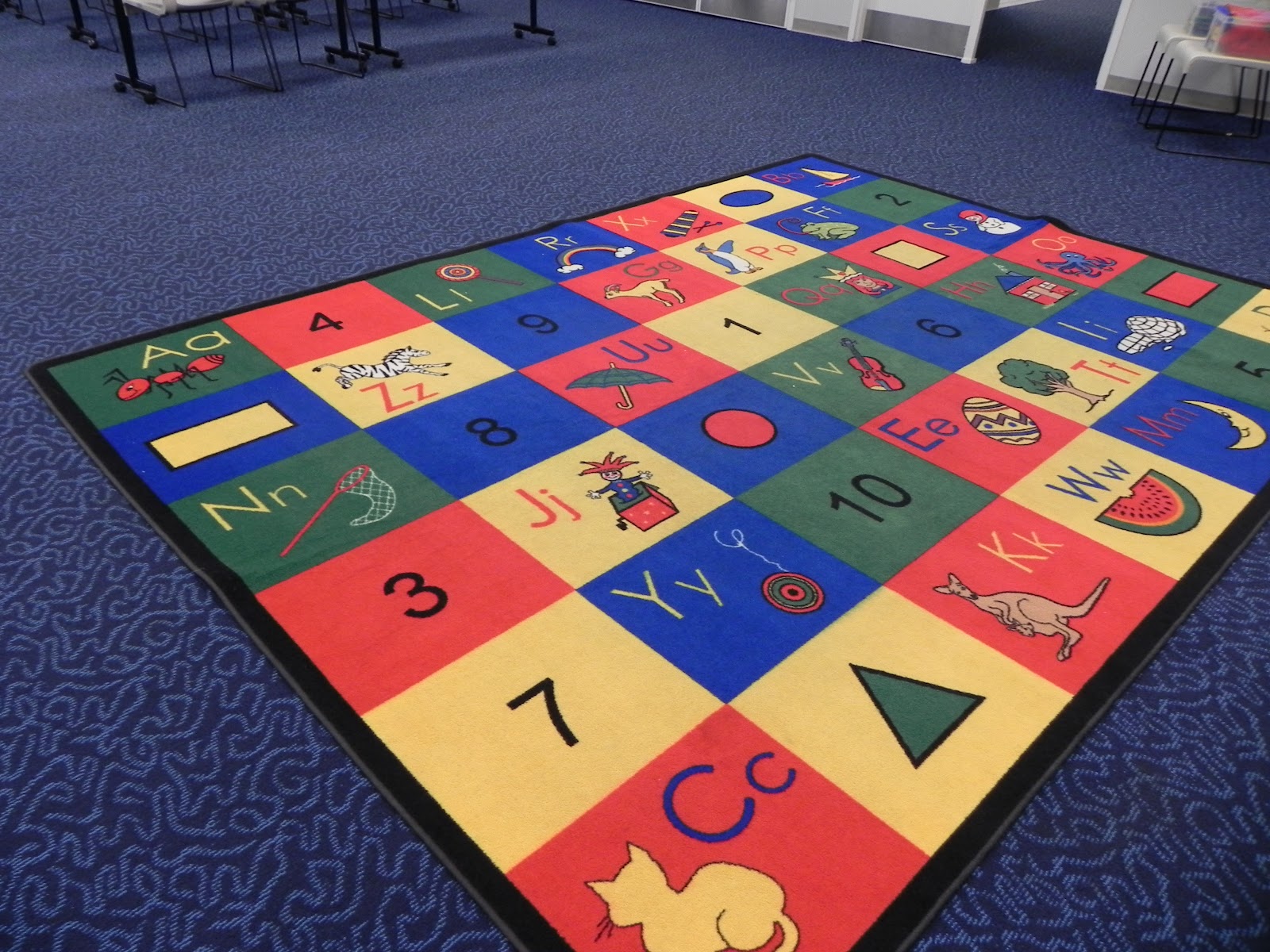
Where do your kids sit? Our story time is in a large meeting room so a smaller carpet helps to give the children visual boundaries. We found this great carpet through Demco and asked our Friends of the Library to purchase it for us. I like it because with each letter, there is a picture, such as C and cat. This reinforces the letter sound. We have the matching carpet squares so kids can play a game, kind of like Memory, where they match the carpet square to the carpet. You can have the kids follow the alphabet (find the "a" square, then find the "b" square). You can also have them pick out the letters in their name.
What in your room is labeled? While you don't have to label everything, why not label the things that you use? All of our props are in labeled boxes. While the kids who attend our story times don't read yet, the labels show that words have meaning.
Can the kids see your books ahead of time? Do you have a sign that gives your theme? When we are ready to start I like to ask the kids what they think that the theme is, especially if I have a book with a really good picture on the front. Today I held up Ten Tiny Babies by Karen Katz. Can you guess the theme? It was babies. Once again, the pictures on the book give meaning to the words.
Tuesday, September 25, 2012
Thursday, September 20, 2012
Flannel Friday-Repurposing Your Flannelboard
I wanted to add a few new flannelboard colors to our collection this week and mentioned it to a colleague. She came up with the great idea of making a flannel background and attaching it to the current one with velcro. So this Flannel Friday post is dedicated to Miss Kara's brilliant idea.
This is our current standup flannelboard.
I started with these supplies in the picture above. Felt was 40% off at JoAnn's this week so I got two colors for under $5. We buy our velcro in bulk from Discount School Supply as we go through a lot of velcro. I laid each piece of felt on top of the feltboard (I had collapsed the feltboard and laid it on a table for easier access) and cut around the edge.
To make the panel a little more sturdy, I added a long strip of velcro across the top of the back and the bottom of the back. I added some along the sides too, but you will want to figure out how you will want to fold your panel for storage before you add the velcro.
The final product
Honestly, I don't know why we didn't think of this years ago. For less than $5 and some velcro (which we had in stock), we now have 2 new flannelboard backgrounds.
Sharon is hosting this week's round-up at Rain Makes Applesauce. For more Flannel Friday fun, check out the Flannel Friday Facebook page, the Flannel Friday blog, or the Flannel Friday Pinterest page.
Wednesday, September 19, 2012
Sensory Story Times
Background
Last year I decided that I needed to try something new so my plan was to run a series of sensory programs in spring 2011. Working in a public library, I often see people with special needs using the building, but they don't have programming that is geared towards their needs.
Before You Start Planning
Think of this like school-before you start, do your homework. I started by looking around the web to see what other libraries are doing and came across this excellent blog post on the ALSC blog. It is a five-part post called Programming for Children with Special Needs by Tricia Bohanon Twarogowski. Around the same time, ALSC offered a webinar by Barbara Klipper at The Ferguson Library called Sensory Storytime: Preschool Programming that Makes Sense for Kids with Autism.
Next, look around your area to see if there are any libraries doing any special needs programming. We noticed that there was no special needs programming in our county, which prompted this program. I remembered seeing a colleague present on autism at a conference that I attended so I started asking her questions as they came up.
The Program
Let me start by saying that you will need a plan with this group and you will want to practice. This is not a programming group to go into blindly. This group needs to see what is going to happen in which order, whether you hang the plan at the front of the room or pass out a schedule to each child (or both).
Since I had never did this before, I borrowed the plan from Tricia's blog for her color story time. We had 3 kids attend with their parents so it was a nice audience for my first sensory story time.
Tips & Tricks
We used a program called Boardmaker to set up our schedule. This is a great program, but is expensive. I was able to download a trial of the program to see if it would fit my needs, then found the program through our Intermediate School District. I am still pushing for my library to pick up the program as it would be useful in any children's story time, but that is a work in progress.
While the kids are coloring at the end of the program, talk with the parents to see if the program fit their needs. Is there anything that they could suggest? They live with special needs children every day and maybe they have a tip or suggestion of something to make the program better.
What I Would Do Next Time
The biggest thing that I would correct next time is the marketing of the program. I made an assumption (wrong, of course) that if we advertised the program in our newsletter and in the library, that people would see it. Why would they look for it if they aren't used to having special needs programming at the library? If you want to run a sensory story time, you have to go to the people to advertise. In our county, I would need to go through our Intermediate School District's special eductaion programs.
You may also get a lot of inquiries from your regular customers to see if they can attend. I probably could have had a room of 60 2 and 3 year olds if I wanted. They thought that the idea of a sensory story time sounded cool, but they totally missed that this was not for their child. It is a good idea to know ahead of time who you are going to let into the program-is it just for special needs children, for special needs children and their families, or can anyone attend?
Thursday, September 13, 2012
Flannel Friday-We're Going on a Leaf Hunt
Fall is definitely on its way up here in Michigan so this is a great time to pull out your favorite fall stories and flannelboards. This week I flannelized We're Going on a Leaf Hunt by Steve Metzger. This works well for a wide variety of ages as there is one-line cumulative text on each page. While the story is similar to We're Going on a Bear Hunt by Michael Rosen, the children stop and pick up different colored and kinds of leaves at each place (such as red maple leaves).
A pattern to make your own version can be found here. I cut all of my pieces out of felt and used puffy paint and glitter glue to add the details.
This week Kay is hosting the Flannel Friday Round-Up at Storytime ABC's. Flannel Friday is also on Pinterest. Make sure you check out the "This Week" board for more fun!
Thursday, September 6, 2012
Flannel Friday-The Goldfish Song
I am excited by this Flannel Friday as this prop has been 1 year in the making. Last fall, I presented at the MLA Annual Conference with 2 colleagues and 1 of them showed me these cool felt goldfish that she used for The Goldfish Song by Laurie Berkner on the cd Victor Vito. I got the pattern from them and started cutting.
The goldfish are all cut from felt. I made a front and a back for each one to make them stiff enough for stick puppets. I used orange, light orange and yellow felt. Each fish has 2 colors-the outside fish part and the inside fish part. I used giant googly eyes to make them fun.
If you haven't used The Goldfish Song before, it is definitely worth a listen. It works especially well with preschool and kindergarten audiences as they will "get" the silliness of the actions. If you don't use fish puppets, you can still mimic the actions in the song and have a great time.
Many thanks to Lisa and Alicia at our South Branch for showing me the goldfish puppets and sharing the pattern. The original pattern can be found at http://familyfun.go.com/assets/cms/pdf/crafts/1005_GoldfishTemplate.pdf. I shrunk it down so two fish would fit on a page (somewhere between 50 and 60%).
This week's Flannel Friday Round-Up is being hosted by Loons & Quines at Librarytime. For more Flannel Friday fun, check out the Flannel Friday blog and the Flannel Friday Pinterest page.
Friday, August 31, 2012
Flannel Friday-Story Time Cape
This week for Flannel Friday I am going to show off one of my non-flannel creations. Once upon a time, my coworker and I were at a conference and got a little slap happy as the afternoon went on. We started joking about what we could make each other to use in story time-she was going to make me a hat and I was going to make her a cape. Well, what started off as a joke ended up as a cool product.
I started off with a basic cape. With Halloween approaching, you can buy one at a lot of Halloween stores (look for Little Red Riding Hood capes). In my case, I had my mom make one because she sews and I do not. Then came the creative part. Since it was a story time cape, it needed stories on it (or at least characters that the kids would recognize). For patterns, I found the various characters on the Internet, then would shrink them down or blow them up so they were all approximately the same size. I used something called fat quarters, which can be found in the quilting section at JoAnn's or Michaels. (If you watch your sales, you can get 4 for $1.) I used the patterns to cut the various colors out of the fat quarter fabric, then used something called Pellon or fusible interfacing to iron the parts onto the cape. To seal the edges, I outlined the characters in puffy paint.
Finished cape
I was impressed at how well the cape turned out. I do ask Kara if she is going to wear the story time cape to her story times, but it doesn't happen often. I also have not seen my story time hat.
Linda at Notes from the Story Room is hosting today's Flannel Friday round-up. For more great flannelboards, check out the Flannel Friday Pinterest page.
Tuesday, August 28, 2012
Visiting other libraries
I am one of those people who when they go on vacation, find various public libraries to visit. So I was very excited when our library director decided that for our staff in-service this year that we were going to visit local libraries to see how they do things. After all, some of the best ideas come from other libraries and librarians.
If you are ever in Metro Detroit, definitely take a trip to the Southfield Public Library. They have a gorgeous building that you can spend all day wandering around in. Their children's room is fun, yet educational, from the stacks of giant books surrounding the picture book area to the benches by the computers with words on them (they look like giant wooden puzzles).
Subscribe to:
Posts (Atom)