In our library, the biography section has horrible circulation. It's one of those areas where books may check out 1 time a year, rather than every three weeks. For the most part, checkouts in this area tend to be assignment driven. I am hoping to change this. Since displays tend to increase circulation, I created a display in the biography section that can rotate as often as we need it to.
This is the "before" picture. As you can see, I have a lot of empty shelf space, which made shifting easy. The problem with shelves like this is that they don't really encourage browsing. Books can easily get lost in a section.
This is the "after" picture. I shifted the first couple of ranges so the first two shelves in the area were empty. If this works, then I may shift a little more so the whole first range is empty. My first display is of baseball players. Baseball is a big thing in Metro Detroit thanks to the Tigers. I plan for the displays to fit various homework assignments (African Americans in February, women in March, etc.) or to pull out cool people who get lost in the section.
Showing posts with label Displays. Show all posts
Thursday, July 31, 2014
Thursday, July 3, 2014
Join the Summer Reading Club
Since I always like to see what other libraries are doing, I am going to show off how we run our summer reading club at my library. Our program is a 10-week program and usually runs from the time that the kids get out of school until the end of August. This year we had a little glitch (millage vote) and had to back up the program by 2 weeks.
Marketing Your Program
I am a big believer that you need to market your program inside of your library. Just about everybody who walks in your front door is a target as almost all of them are already checking out books. Unfortunately, many people don't understand that summer reading is a program that we run-they think that it is just reading in the summer. It is up to us to explain the program and get them to participate.
I believe in the rule of 7-you need to see something 7 times for it to stick in your brain. If you look around my department, you will see summer reading signs everywhere.
Our standee from Upstart has been by the reference desk in past years. Unfortunately, not everybody comes up to the desk. Think of when you go shopping. Do you stop by the customer service desk every time you go? I moved the standee so you can now see it right when you get off the elevator on our floor. By adding the words "join" and "June 2-August 9" to the sign it helps to reinforce that this is a program that you want to do.
This display is right next to the reference desk. While we also have forms behind the desk, this is a self-service station. On this display we have both the kids and teen forms, the ALSC grade level booklists, our summer scavenger hunt form, a sign describing the two programs, and sign with our weekly top 10 schools by summer reading participation. On the next side of this display, we have individual grade level booklists.
These stars appear throughout the department. They are on every OPAC, our reference desk computers, the Activity Room doors, and inside the Story Time Room.
The Actual Program
Our kids program is designed with 60 spaces on our gameboard. Language matters-gameboard sounds much more fun than reading log. Kids under 5 count every book equals 1 space. Kids over 5 count ever 15 minutes reading as one space. We aren't super picky if somebody wants to do the program one way or another. The big point is that they are reading. Every time they complete 20 spaces, they come in for a prize.
Our first prize is a choice from the treasure box. This year we have mustache pens, stampers, magnifying glasses, bouncing balls, and clip-on critters in the treasure chest. Kids also get a sticker (see below) and write their name on a die cut to add to our window (see below).
In addition to being a cool display, this generates interest in the program. We have kids asking us how they can put their name on the window. This gives us the opportunity to explain the program.
We make these stickers in-house using Avery circle labels. While stickers are always a cool prize, many of our kids put them on right away and wear them out in public. It is free library advertising!
When kids come in for their second prize, they get to spin the prize wheel. Honestly, a prize wheel is awesome for generating interest in our program. Kids are always coming up and asking if they can spin the wheel. When we explain that it is a prize, they take the form.
Each number on the wheel corresponds to a different prize. We have rubberband bracelets, Smencils, animal finger puppets, a ball game, and color changing soccer and footballs. By having them numbered, this gives the staff member a chance to switch the prize if it wouldn't be appropriate for the child. After all, what 10 year old wants a finger puppet.
For their third prize, we pass out books. We visit our local Scholastic Warehouse sale every May and stock up on quality books for a great price. Kids also get a packet of stuff including their above and beyond gameboard and free coupons to fun places (roller skating and bowling).
Since you have to worry about prizes being safe for kids under 3, we have a special bucket for baby prizes. While some want the same prizes as their big brothers and sisters (which we let them if their parent okays it), they love being able to choose their own prizes too. Their bucket includes rubber duckies, bubbles, and plastic shovels. They also get to pick out a free book as their last prize.
That is our program for this year! We are always trying to change things up in terms of what our community wants and what would be the best use of our money. We already have some great ideas for next year, but our whole team will sit down in September to evaluate the program.
Just for fun, this is the "before" picture for summer reading.
Marketing Your Program
I am a big believer that you need to market your program inside of your library. Just about everybody who walks in your front door is a target as almost all of them are already checking out books. Unfortunately, many people don't understand that summer reading is a program that we run-they think that it is just reading in the summer. It is up to us to explain the program and get them to participate.
I believe in the rule of 7-you need to see something 7 times for it to stick in your brain. If you look around my department, you will see summer reading signs everywhere.
Our standee from Upstart has been by the reference desk in past years. Unfortunately, not everybody comes up to the desk. Think of when you go shopping. Do you stop by the customer service desk every time you go? I moved the standee so you can now see it right when you get off the elevator on our floor. By adding the words "join" and "June 2-August 9" to the sign it helps to reinforce that this is a program that you want to do.
This display is right next to the reference desk. While we also have forms behind the desk, this is a self-service station. On this display we have both the kids and teen forms, the ALSC grade level booklists, our summer scavenger hunt form, a sign describing the two programs, and sign with our weekly top 10 schools by summer reading participation. On the next side of this display, we have individual grade level booklists.
These stars appear throughout the department. They are on every OPAC, our reference desk computers, the Activity Room doors, and inside the Story Time Room.
The Actual Program
Our kids program is designed with 60 spaces on our gameboard. Language matters-gameboard sounds much more fun than reading log. Kids under 5 count every book equals 1 space. Kids over 5 count ever 15 minutes reading as one space. We aren't super picky if somebody wants to do the program one way or another. The big point is that they are reading. Every time they complete 20 spaces, they come in for a prize.
Our first prize is a choice from the treasure box. This year we have mustache pens, stampers, magnifying glasses, bouncing balls, and clip-on critters in the treasure chest. Kids also get a sticker (see below) and write their name on a die cut to add to our window (see below).
In addition to being a cool display, this generates interest in the program. We have kids asking us how they can put their name on the window. This gives us the opportunity to explain the program.
We make these stickers in-house using Avery circle labels. While stickers are always a cool prize, many of our kids put them on right away and wear them out in public. It is free library advertising!
When kids come in for their second prize, they get to spin the prize wheel. Honestly, a prize wheel is awesome for generating interest in our program. Kids are always coming up and asking if they can spin the wheel. When we explain that it is a prize, they take the form.
Each number on the wheel corresponds to a different prize. We have rubberband bracelets, Smencils, animal finger puppets, a ball game, and color changing soccer and footballs. By having them numbered, this gives the staff member a chance to switch the prize if it wouldn't be appropriate for the child. After all, what 10 year old wants a finger puppet.
For their third prize, we pass out books. We visit our local Scholastic Warehouse sale every May and stock up on quality books for a great price. Kids also get a packet of stuff including their above and beyond gameboard and free coupons to fun places (roller skating and bowling).
Since you have to worry about prizes being safe for kids under 3, we have a special bucket for baby prizes. While some want the same prizes as their big brothers and sisters (which we let them if their parent okays it), they love being able to choose their own prizes too. Their bucket includes rubber duckies, bubbles, and plastic shovels. They also get to pick out a free book as their last prize.
That is our program for this year! We are always trying to change things up in terms of what our community wants and what would be the best use of our money. We already have some great ideas for next year, but our whole team will sit down in September to evaluate the program.
Just for fun, this is the "before" picture for summer reading.
Saturday, June 14, 2014
Awesome Jar
This idea originally came from Sara at Bryce Don't Play. I took her original idea, made it fit my building, and added some new twists.
We have a set of display shelves in my department that nobody ever wants to refill. I decided that we would let the customers do it themselves and we would fill in where needed (and monitor it). I started with an empty plastic jar and labeled it the "Awesome Jar". I put out slips of paper asking for a person's first name and an awesome book that they have read. When books are low on the shelves, I raid the slips in the jar for more titles.
This was our display when I set it up.
To get more mileage out of people's recommendations, I am also tweeting them out every so often. If you check the hashtag #cmplawesomejar, you will see a couple of our titles so far. Now that people are seeing these recommendations and the display, the jar is filling up!
Thursday, April 24, 2014
Revamping Our Parent-Teacher Collection
My new location has a parent-teacher collection, which is an important component of a children's room. After all, parents and teachers are using your collection already. Why not add some of their stuff in too? Unfortunately, there were a number of problems that I came into with this collection. Here are some of the ways that I solved them.
Problem #1-The collection itself
There were very few books added (under 10/year) and much of the collection was our weeded professional reference books. I started with pulling the stats by Dewey number (we use Relative Use and circulation stats) and doing a massive weeding project. Honestly, very few people want to check out our old books about planning a summer reading program.
Then came the purchasing of new books. Our children's budget at the moment is one large pot so there is no money specified for specific collections and nobody is in charge of making sure stuff is bought. This makes it easy to forget when ordering. Next fiscal year, we will be dividing up our budget based on what's being used and members of the department will be in charge of the entire collection development cycle for that collection.
To get us started for this year, I did purchase new items. This is one of those collections where you have to look outside the normal journals to find quality items. Here are some of my sources.
Problem #2-Location & Signage
The collection was in the far back corner of the department and the signage was to the left of the shelves. When standing in front of the books, it was difficult to tell what they were. When standing in front of the books, it was difficult to tell what they were.
Since there was empty space after the weeding project, I shifted the books to free up the top shelf. I created a sign that highlighted new books and displayed them on this shelf. Plus, the sign has "Parent-Teacher" right at the top so it makes it a bit more obvious what is in the collection. The sign has both cover art and Dewey numbers so staff can pull more items to add to the display as items are checked out.
Based on observation and stats, the changes seem to be working. Have you had to revamp a collection? How did you do it?
Problem #1-The collection itself
There were very few books added (under 10/year) and much of the collection was our weeded professional reference books. I started with pulling the stats by Dewey number (we use Relative Use and circulation stats) and doing a massive weeding project. Honestly, very few people want to check out our old books about planning a summer reading program.
Then came the purchasing of new books. Our children's budget at the moment is one large pot so there is no money specified for specific collections and nobody is in charge of making sure stuff is bought. This makes it easy to forget when ordering. Next fiscal year, we will be dividing up our budget based on what's being used and members of the department will be in charge of the entire collection development cycle for that collection.
To get us started for this year, I did purchase new items. This is one of those collections where you have to look outside the normal journals to find quality items. Here are some of my sources.
- Lakeshore Learning-books are split by subject area in the store so it is easy to look for books for a specific Dewey range or subject area.
- Barnes and Noble-I went through both the parenting and education sections and looked for multiple copies, glossy covers, and subjects where our stats showed more books were needed.
- Other libraries with similar collections-We have a local library who has an awesome parent-teacher collection and used to put all of their new books up on their web site. It was easy for me to go through their list and see what would fit our collection. It also showed me different publishers to check.
- Publisher's web sites-I am a big fan of Mailbox Books because their selections have ready-to-go projects and lesson plans that can be adapted for both teachers and parents.
Problem #2-Location & Signage
The collection was in the far back corner of the department and the signage was to the left of the shelves. When standing in front of the books, it was difficult to tell what they were. When standing in front of the books, it was difficult to tell what they were.
Since there was empty space after the weeding project, I shifted the books to free up the top shelf. I created a sign that highlighted new books and displayed them on this shelf. Plus, the sign has "Parent-Teacher" right at the top so it makes it a bit more obvious what is in the collection. The sign has both cover art and Dewey numbers so staff can pull more items to add to the display as items are checked out.
Based on observation and stats, the changes seem to be working. Have you had to revamp a collection? How did you do it?
Tuesday, January 28, 2014
Face Outs Make a Difference
If you have seen some of my display posts in the past, you will know that I am a big fan of seeing what works in the retail world and adopting it in my library. Any time I can face out a book, display it on shelves, or some other option, it helps it to circ. As we know in the library world, circulation is important or items get weeded.
This inspiration came from a local bookstore (you may recognize it).
As you can see, this display looks neat. You can see all of the book covers, which makes you want to pick up a copy (or five) for purchase.
We recently "found" some shelf space and our new nonfiction moved to fill it. Since moving it here and using the face out method, I am constantly filling holes. These books are now flying off the shelves. Plus, they are right at the beginning of the nonfiction section now (rather than the easy reader area which didn't make sense).
This inspiration came from a local bookstore (you may recognize it).
As you can see, this display looks neat. You can see all of the book covers, which makes you want to pick up a copy (or five) for purchase.
We recently "found" some shelf space and our new nonfiction moved to fill it. Since moving it here and using the face out method, I am constantly filling holes. These books are now flying off the shelves. Plus, they are right at the beginning of the nonfiction section now (rather than the easy reader area which didn't make sense).
Thursday, December 19, 2013
My First Bulletin Board
One of the things that I love in my new children's area is the display space. There are a lot of opportunities to show off books, programs, or new ideas. The one that I tackled this week is our giant bulletin board where we post program posters. This is a floor-to-ceiling bulletin board right as you enter the department.
To start with, I covered the bulletin board with roll paper. Unfortunately, I learned that while I am good at many things, using roll paper is not one of them.
Next I added my design. I wanted something that was not winter-specific. Otherwise, as soon as the snow melts here, the board would need to be changed. I also wanted it to be interactive.
Finally, I hung up our program posters. I learned that if your paper is bumpy or bubbled, nobody will notice if you put a poster over it.
For the interactive portion, I added a sign that matches our writing and activity centers. I am hoping that parents will learn to look for these signs throughout the department, but I have to start small.
We, as librarians, know early literacy like the back of our hand. It helps to give parents ideas of how they can play too. You will soon find them naturally adding early literacy activities to their daily lives.
It has been two days since the bulletin board has gone up. While our toy trains are still the most favorite part of the department, almost every child who walks by the bulletin board has to sing the ABC song. It is fun to watch!
To start with, I covered the bulletin board with roll paper. Unfortunately, I learned that while I am good at many things, using roll paper is not one of them.
Next I added my design. I wanted something that was not winter-specific. Otherwise, as soon as the snow melts here, the board would need to be changed. I also wanted it to be interactive.
Finally, I hung up our program posters. I learned that if your paper is bumpy or bubbled, nobody will notice if you put a poster over it.
For the interactive portion, I added a sign that matches our writing and activity centers. I am hoping that parents will learn to look for these signs throughout the department, but I have to start small.
We, as librarians, know early literacy like the back of our hand. It helps to give parents ideas of how they can play too. You will soon find them naturally adding early literacy activities to their daily lives.
It has been two days since the bulletin board has gone up. While our toy trains are still the most favorite part of the department, almost every child who walks by the bulletin board has to sing the ABC song. It is fun to watch!
Tuesday, December 3, 2013
Most Popular Books of 2013
I started putting together a "best books" display this morning based on all of the fun best book lists, when I got sidetracked by wanting to add in my library's most popular books. Well, the display took a turn and ended up being just our most popular circing children's books of 2013.
To make it look nicer, I was able to pull multiple copies of many of the books and stack them. When I stack my books, I like to turn the ones lying flat into a spiral to add interest (similar to what you would do with party napkins). To add a guessing element to the display, listed the titles in order on the back of my display sign. This way customers can guess if their favorite titles are on the list, then check to see if they were right. It also helps staff pull more titles to add to the display.
If you are wondering what our most popular children's titles of 2013 have been, here is the list in order:
To make it look nicer, I was able to pull multiple copies of many of the books and stack them. When I stack my books, I like to turn the ones lying flat into a spiral to add interest (similar to what you would do with party napkins). To add a guessing element to the display, listed the titles in order on the back of my display sign. This way customers can guess if their favorite titles are on the list, then check to see if they were right. It also helps staff pull more titles to add to the display.
If you are wondering what our most popular children's titles of 2013 have been, here is the list in order:
- Diary of a Wimpy Kid: The Third Wheel
- Diary of a Wimpy Kid: Cabin Fever
- Diary of a Wimpy Kid: Dog Days
- Diary of a Wimpy Kid: Rodrick Rules
- Diary of a Wimpy Kid: The Last Straw
- Diary of a Wimpy Kid: Greg Heffley's Journal
- Diary of a Wimpy Kid: The Ugly Truth
- The Lightning Thief
- Harry Potter and the Sorcerer's Stone
- Green Eggs and Ham
- Junie B., First Grader: Aloha-ha-ha!
- The Sea of Monsters
- Junie B., First Grader: Jingle Bells, Batman Smells! (P.S. So Does May.)
- The Cat in the Hat
- If You Give a Cat a Cupcake
- The Very Hungry Caterpillar
- Harry Potter and the Deathly Hallows
- Junie B., First Grader: Boo-And I Mean It!
- Captain Underpants and the Preposterous Plight of the Purple Potty People
- Junie B., First Grader: Dumb Bunny
- Hop on Pop
- If You Give a Mouse a Cookie
- Harry Potter and the Prisoner of Azkaban
- Heroes of Olympus: The Son of Neptune
- Junie B., First Grader: Cheater Pants
Saturday, November 2, 2013
Picture Book Month Display
This month's fun display is celebrating Picture Book Month. For me, this is a GREAT department display. Why?
- Picture Book Month promotes materials for half of our age group. Plus, they have promo materials right on their web site!
- There are enough books to support a display so staff don't have to totally change the theme more often that every 2 weeks-1 month.
- As we all purchase picture books in our department, we are all experts and should be able to refill the display as books are used.
Ta-da!
How to make your own Picture Book Month display:
- Pull out your favorite picture books, those that you feel should be represented, or those that have gotten lost in your department and are on the brink of being weeded.
- Find some space. Above is an awesome display space for my department. It is at the end of a shelving unit and is on the main traffic path for the department. Most everybody walks by this display.
- Print off a sign or promo materials from the Picture Book Month web site. Signage should look nice. If you put it in a plexi stand, make sure the plexi is not cracked or broken. If you don't have a plexi stand, try laminating the sign.
- Arrange your books. It really is a skill to make a display look good. Size and color matter! I start by putting my tallest books in the middle of each shelf and building around them. Similar colors should be near each other. For example, you can see on the Pete the Cat: I Love My White Shoes has a lot of yellow. To tie in with Pete the Cat, the lettering in A Pocket for Corduroy is also yellow and there are yellow details on the George and Martha book.
- Enjoy watching people use your display. Remember that it is not annoying to refill the display multiple times a day. In a good display, the books will disappear.
Wednesday, August 14, 2013
Bookstore Displays
One of the things that I really like about bookstores is that they do faceouts. This means that they turn the books so you can see the cover art, rather than the spine labels. While this isn't totally practical for a library setting, why can't you take the 10 copies of each Rick Riordan title and flip them to show the covers. In addition to giving the section some interest, you will actually save shelf space.
If you are at your local Barnes and Noble, definitely take a walk through their teen section. They have taken faceouts to a new level.
Almost the teen entire section is faceouts. As we all know, cover art makes or breaks a book sale and the same is true in libraries. This is great for a browser, but difficult for a person looking for a specific book. It took me 10 minutes to find a copy of Divergent by Veronica Roth and I know what the cover looks like!
Where we can put this into practice is to make each shelf on an empty range a different display. In the picture above, each shelf sign gives a different category of popular titles. The top shelf includes the bestsellers. Another shelf includes great books for girls. If you want to see what this looks like in a library setting, check out Storytime Katie's Tumblr post from May where she created a bunch of "If you liked, then try" shelves.
Wednesday, July 3, 2013
Summer Displays
If you have seen my displays in the past here, you will know that we have 1 display space in our building for kids' books. It is kind of shoved in at the beginning of the jbio area, which is not a high traffic area. During the school year, I highlight various nonfiction areas, which coincide with whatever reports the kids are doing. Since it is summer vacation, I had to come up with something else.
Our summer display is called "I'm bored...What can I do on summer vacation?" The nice thing about this display is that you can put any kind of activity book on it, which covers a wide range of nonfiction. To create your own, check out some of these dewey numbers:
- 509-science experiments
- 636-pets (I always look for How to Talk to Your Dog by Jean Craighead George)
- 641-cooking
- 688.725-Lego books
- 741-how to draw
- 745-crafts & hobbies
- 790-sleepover parties
- 793.8-magic
- 796-sports
- 917-travel (anything for families around your state?)
Wednesday, June 19, 2013
Dinosaur Feet
When shopping for summer reading this winter, I saw this great product from Discount School Supply. We have a lot of active programs during the summer and a large meeting room to put it in. I just didn't know how to tie it all together. So the product came in and sat under my desk til today when I had inspiration.
In addition, there are 20 dinosaur egg circles that can correspond with each of the footprints. While you can match the circles and work on your early childhood math skills, I personally have been using it as a hopscotch-like mat. In addition to being fun, this works on gross motor skills.
All of our programs are held in a large meeting room that seats 100 people. This includes outside performers, story times, etc. The sides of the room have large metallic doors which I have adopted as display space since we really don't have any in the library. Above is the completed dino feet display so you can see the whole thing.
I made a giant T-Rex foot. Yes, the size is accurate. There is a nearby label that says "A T-Rex foot was 3.3 feet long."
Then I traced my foot on purple. I added another sign that says, "Mrs. Lisa's foot is 9 inches long." To get the kids (and their parents) thinking, I made a couple more signs:
Above is Dino Stomp Line Activity Mat from Discount School Supply. It is 20 feet long. While you can't totally see it, along the right side is a ruler with the inches and feet marked off. There are 20 numbered dino footprints.
All of our programs are held in a large meeting room that seats 100 people. This includes outside performers, story times, etc. The sides of the room have large metallic doors which I have adopted as display space since we really don't have any in the library. Above is the completed dino feet display so you can see the whole thing.
I made a giant T-Rex foot. Yes, the size is accurate. There is a nearby label that says "A T-Rex foot was 3.3 feet long."
Then I traced my foot on purple. I added another sign that says, "Mrs. Lisa's foot is 9 inches long." To get the kids (and their parents) thinking, I made a couple more signs:
- How big is your foot?
- Which foot is the biggest? The littlest?
- You can fit about 20 of Mrs. Lisa's feet in T-Rex's footprint.
Thursday, June 13, 2013
Summer Reading Window Display
Okay, I will admit that I was really procrastinating on decorating our front window as I had no idea what to use. It is an important space as it is our one creative space in the library to decorate for summer reading. My idea of Dig into Reading tends to veer towards dinosaurs and construction, rather than moles and other underground animals. I also knew that whatever we designed had to be big and bright enough to fill the front window so you can see it from the road. My partner-in-crime, Kara, and I put our heads together and came up with...
Since our front window also is one wall of our lobby, we like to make our pictures double-sided. The kids love being able to see things up close (and we love the bright colors). The large flowers helped to fill up the window space and provide bright colors and shapes that you can see from the road.
Since I am not really an underground animal type of person (moles do make me shudder), we ended up with 2 big ant hills.
The hills are cut freeform. To get a pattern for the ants, I put 3 large circles together on a piece of 11x17 paper. There are sticker eyes on both sides (outside and lobby) of the ants. The legs are strips of paper cut down to be the same size.
Green grass runs along most of the window. I like it because it gives the window a 3-D effect. To make your own, cut strips about 1 inch wide along the top of a piece of paper. I used scotch tape every 3-4 strips to help hold the grass up and to give it some dimension (after all, you don't want all of the grass curled over).
We had some leftover paper and window space so we added a few bugs. To make the shape of the bee, I set up a 11x17 page in Microsoft Publisher and made two circles. One I stretched long to make the body and the other I left normal for the head. Our bee has sticker eyes (to tie him together with the ants). We used a Sharpie marker to color in the stripes and add a mustache. We have a lot of mustache-themed prizes this year and wanted to tie the mustache into the display. It also gives it a bit of whimsy. The wings are cut out of wax paper and are teardrop-shaped.
Our other bug was a ladybug. It uses the same shape as the bee and is cut out of a dark pinkish-red paper. He has sticker eyes (like the ant and the bee) and his spots and details are colored with permanent marker. His antennae are made out of black pipe cleaners and have curled ends.
I couldn't resist adding a bit of construction to our display. We just changed to words to read "Summer Reading Zone". It is a yellow diamond and a brown rectangle with the lettering done with permanent markers.
Our entire display took about 4 hours to put together and cost a grand total of $3.96. We were able to buy the paper from our local ISD Teacher's Workshop, which sells giant roll paper by the foot.
Since our front window also is one wall of our lobby, we like to make our pictures double-sided. The kids love being able to see things up close (and we love the bright colors). The large flowers helped to fill up the window space and provide bright colors and shapes that you can see from the road.
Since I am not really an underground animal type of person (moles do make me shudder), we ended up with 2 big ant hills.
The hills are cut freeform. To get a pattern for the ants, I put 3 large circles together on a piece of 11x17 paper. There are sticker eyes on both sides (outside and lobby) of the ants. The legs are strips of paper cut down to be the same size.
Green grass runs along most of the window. I like it because it gives the window a 3-D effect. To make your own, cut strips about 1 inch wide along the top of a piece of paper. I used scotch tape every 3-4 strips to help hold the grass up and to give it some dimension (after all, you don't want all of the grass curled over).
We had some leftover paper and window space so we added a few bugs. To make the shape of the bee, I set up a 11x17 page in Microsoft Publisher and made two circles. One I stretched long to make the body and the other I left normal for the head. Our bee has sticker eyes (to tie him together with the ants). We used a Sharpie marker to color in the stripes and add a mustache. We have a lot of mustache-themed prizes this year and wanted to tie the mustache into the display. It also gives it a bit of whimsy. The wings are cut out of wax paper and are teardrop-shaped.
Our other bug was a ladybug. It uses the same shape as the bee and is cut out of a dark pinkish-red paper. He has sticker eyes (like the ant and the bee) and his spots and details are colored with permanent marker. His antennae are made out of black pipe cleaners and have curled ends.
I couldn't resist adding a bit of construction to our display. We just changed to words to read "Summer Reading Zone". It is a yellow diamond and a brown rectangle with the lettering done with permanent markers.
Our entire display took about 4 hours to put together and cost a grand total of $3.96. We were able to buy the paper from our local ISD Teacher's Workshop, which sells giant roll paper by the foot.
Friday, May 24, 2013
Fun with Displays
You know those days where all of the kids have the same assignment? While this happens a lot, the one that is our least favorite is Michigan biographies. It seems as if all the classes in our service area have the same assignment at the same time to coincide with Michigan week at the end of May. Now I don't know how familiar you are with Michigan. We have a lot of nice things going for us-camping, lakes, etc. When you talk about famous people, not so much. Then there is the fact that there are very few books written on the Michigan famous people other than Henry Ford and Rosa Parks. The kids who come in on the first day the assignment is passed out are all set. It's those kids who wait until the last minute that really need our help.
This is our Michigan biographies display. I like it because it helps the librarian quickly see if there are any biographies available. It also gives the kids a choice in famous people instead of just giving us a blank look when you ask who their report is on. We had to really stretch to pull this one together. Anyone with any sort of Michigan connection is pulled, whether they were born here, still live here, or played for a sports team.
In addition, we have a sign highlighting our Biography In Context database. This is to help those kids who need multiple sources for their report.
Here are today's tips for creating a display:
1. The area you are using should be clean (not dusty). After all, if you see dusty items on store shelves, do you really want to buy them?
2. If you are using sign holders, they should be in good condition. This includes no big scratches or cracks.
3. Pull visually pleasing titles. I like ones with bright colors or fun illustrations on the front. Covers should be in good condition, even if you have to add some book tape or replace the book cover. This is a good time to check over the section for books in need of repair.
4. Size matters-it creates interest. Big items should be in the middle and little items should be on the outside (think pyramid). This will draw your viewers eyes into the display. You can also start small and continually get bigger (like on my second shelf above), similar to a ramp. This is something, though, that you only want to do once and not throughout the whole display or it will look chaotic.
5. Can you pull items from more than one section? Can you add dvds? While I didn't do it here due to the theme, this makes the display fun. It also highlights your different collections. I get a lot of people saying, "Oh, I didn't know that you carried_________."
6. Can you pull in a web presence? This could be QR codes, highlighting your databases, or taking a picture and posting it on your library's Twitter account. With so many people having mobile technology, this is a great way to reach them.
7. Do you need a sign? Some displays are obvious, such as all books on the Titanic, and wouldn't need one. Some need a little help or you want to make a connection with something, such as a Michigan biography display and a Michigan biography assignment. You want the lightbulb to go off in people's minds when they see it.
8. Refill. Refill. Refill. No matter how much it excites you to see empty holes because it means the books are going out, the point is to highlight your collection. You can't do that if people can't see the items.
Random display fun-if you are out shopping at one of your favorite stores, pull out your smartphone and snap a picture of displays that interest you. Go home and look at the picture again and figure out why the display was appealing-was it colorful? Was it filled with items? Was there something else? Stores have merchandisers and libraries don't. This gives you a chance to learn some tips from them.
This is our Michigan biographies display. I like it because it helps the librarian quickly see if there are any biographies available. It also gives the kids a choice in famous people instead of just giving us a blank look when you ask who their report is on. We had to really stretch to pull this one together. Anyone with any sort of Michigan connection is pulled, whether they were born here, still live here, or played for a sports team.
In addition, we have a sign highlighting our Biography In Context database. This is to help those kids who need multiple sources for their report.
Here are today's tips for creating a display:
1. The area you are using should be clean (not dusty). After all, if you see dusty items on store shelves, do you really want to buy them?
2. If you are using sign holders, they should be in good condition. This includes no big scratches or cracks.
3. Pull visually pleasing titles. I like ones with bright colors or fun illustrations on the front. Covers should be in good condition, even if you have to add some book tape or replace the book cover. This is a good time to check over the section for books in need of repair.
4. Size matters-it creates interest. Big items should be in the middle and little items should be on the outside (think pyramid). This will draw your viewers eyes into the display. You can also start small and continually get bigger (like on my second shelf above), similar to a ramp. This is something, though, that you only want to do once and not throughout the whole display or it will look chaotic.
5. Can you pull items from more than one section? Can you add dvds? While I didn't do it here due to the theme, this makes the display fun. It also highlights your different collections. I get a lot of people saying, "Oh, I didn't know that you carried_________."
6. Can you pull in a web presence? This could be QR codes, highlighting your databases, or taking a picture and posting it on your library's Twitter account. With so many people having mobile technology, this is a great way to reach them.
7. Do you need a sign? Some displays are obvious, such as all books on the Titanic, and wouldn't need one. Some need a little help or you want to make a connection with something, such as a Michigan biography display and a Michigan biography assignment. You want the lightbulb to go off in people's minds when they see it.
8. Refill. Refill. Refill. No matter how much it excites you to see empty holes because it means the books are going out, the point is to highlight your collection. You can't do that if people can't see the items.
Random display fun-if you are out shopping at one of your favorite stores, pull out your smartphone and snap a picture of displays that interest you. Go home and look at the picture again and figure out why the display was appealing-was it colorful? Was it filled with items? Was there something else? Stores have merchandisers and libraries don't. This gives you a chance to learn some tips from them.
Tuesday, April 30, 2013
Nonfiction Promotion
If you are familiar with my library, you will know that we have almost no display space. Our endcaps are also all metal, rather than slatwall, so we can't display at the ends of our ranges. This makes it really difficult to increase circulation of our nonfiction for anything other than homework or hot topics (dinosaurs, animals, etc.)
We did come up with a good solution. Since the endcaps are metal, magnets would stick to them. We found plastic magnetic sign holders through Demco and purchased a couple of them. Then we looked for a way to highlight nonfiction books on in these sign holders. So we don't clutter up our endcaps, we have 2 sign holders in our nonfiction area. One sign rotates monthly through different themes. For example, April is National Poetry Month. In addition to a title, we include cover art, titles, and call numbers. This way if someone sees something that they like on the sign, they can find it on the shelf and take it home.
Our other sign rotates less frequently (normally quarterly). It is still built around a theme. Two recent ones we have had are Cinderella stories (or fairy tales do not circulate well) and Caldecott Nonfiction Winners (see below).
.
While the signs don't provide the instant gratification for people who just want to pick a book off of a display, they do provide the tools to find them. It is a fun way to highlight different areas of our nonfiction section.
We did come up with a good solution. Since the endcaps are metal, magnets would stick to them. We found plastic magnetic sign holders through Demco and purchased a couple of them. Then we looked for a way to highlight nonfiction books on in these sign holders. So we don't clutter up our endcaps, we have 2 sign holders in our nonfiction area. One sign rotates monthly through different themes. For example, April is National Poetry Month. In addition to a title, we include cover art, titles, and call numbers. This way if someone sees something that they like on the sign, they can find it on the shelf and take it home.
Our other sign rotates less frequently (normally quarterly). It is still built around a theme. Two recent ones we have had are Cinderella stories (or fairy tales do not circulate well) and Caldecott Nonfiction Winners (see below).
.
While the signs don't provide the instant gratification for people who just want to pick a book off of a display, they do provide the tools to find them. It is a fun way to highlight different areas of our nonfiction section.
Wednesday, April 17, 2013
Poetry Month Display
This is a display that I have been looking forward to putting together because it encompasses so many different sections. Poetry is an area that really speaks to Common Core because there are many fun ways you can pair the books. I try to share something a little different every time I write a post on displays (feel free to check out the tag on the right for past posts). This time I am going to talk about what books to use.
While you could highlight only your poetry section (811.54), chances are that customers are already finding it. We have a lot of school assignments here where kids are required to read poetry. The first kids always pull all of the Shel Silverstein books and then they choose based on length and covers (we all remember what it was like to be in school and have five assignments at once).
Let's start by pulling some fiction into this display. While it may be shelved in your jfic area, there are great books that really are poetry. Why not pair them with poetry? Three examples that come to my mind are Out of the Dust by Karen Hesse, Diamond Willow by Helen Frost, and Love that Dog by Sharon Creech. There are more, especially if you search the YA area too. An added bonus for us is that all three of these books have won awards (1 Newbery and 2 Mitten).
Next up, why not check out your nursery rhyme section (398.8). While many are for the younger set, there are some good books for older kids. Personally, I like Mother Goose Numbers on the Loose by Leo and Diane Dillon. Also, there is nothing that says that a display has to be geared towards one age group. You can use a book or 2 for little kids. They like poetry too. I pulled out Lucy Cousins Book of Nursery Rhymes as my display seems to have a lot of blue books.
Have you forgotten to check the biography section? Even if you don't have a lot of books on poets, chances are good that you have at least one book on Shakespeare.
Is there a way that you can pull your databases into the display? We pay good money for them and this is a way to highlight them to your customers. Two that we use here that would fit are Biography InContext and Literature Resource Center.
A sign helps to pull the entire display together. You don't always have to be obvious, such as by saying "National Poetry Month". This month I used a Wordle of poets' names (also to remind me how to refill the display).
Finally, raid your poetry section. Personally, I would skip the books that everyone already checks out. This is your chance to highlight other fun titles. Also, don't forget to check your 821 section (British poetry).
Our final product has many different areas of the library represented, from fiction to nursery rhymes to databases. I really like how it turned out this month.
While you could highlight only your poetry section (811.54), chances are that customers are already finding it. We have a lot of school assignments here where kids are required to read poetry. The first kids always pull all of the Shel Silverstein books and then they choose based on length and covers (we all remember what it was like to be in school and have five assignments at once).
Let's start by pulling some fiction into this display. While it may be shelved in your jfic area, there are great books that really are poetry. Why not pair them with poetry? Three examples that come to my mind are Out of the Dust by Karen Hesse, Diamond Willow by Helen Frost, and Love that Dog by Sharon Creech. There are more, especially if you search the YA area too. An added bonus for us is that all three of these books have won awards (1 Newbery and 2 Mitten).
Next up, why not check out your nursery rhyme section (398.8). While many are for the younger set, there are some good books for older kids. Personally, I like Mother Goose Numbers on the Loose by Leo and Diane Dillon. Also, there is nothing that says that a display has to be geared towards one age group. You can use a book or 2 for little kids. They like poetry too. I pulled out Lucy Cousins Book of Nursery Rhymes as my display seems to have a lot of blue books.
Have you forgotten to check the biography section? Even if you don't have a lot of books on poets, chances are good that you have at least one book on Shakespeare.
Is there a way that you can pull your databases into the display? We pay good money for them and this is a way to highlight them to your customers. Two that we use here that would fit are Biography InContext and Literature Resource Center.
A sign helps to pull the entire display together. You don't always have to be obvious, such as by saying "National Poetry Month". This month I used a Wordle of poets' names (also to remind me how to refill the display).
Finally, raid your poetry section. Personally, I would skip the books that everyone already checks out. This is your chance to highlight other fun titles. Also, don't forget to check your 821 section (British poetry).
Our final product has many different areas of the library represented, from fiction to nursery rhymes to databases. I really like how it turned out this month.
Thursday, March 14, 2013
How to Make a Good Display
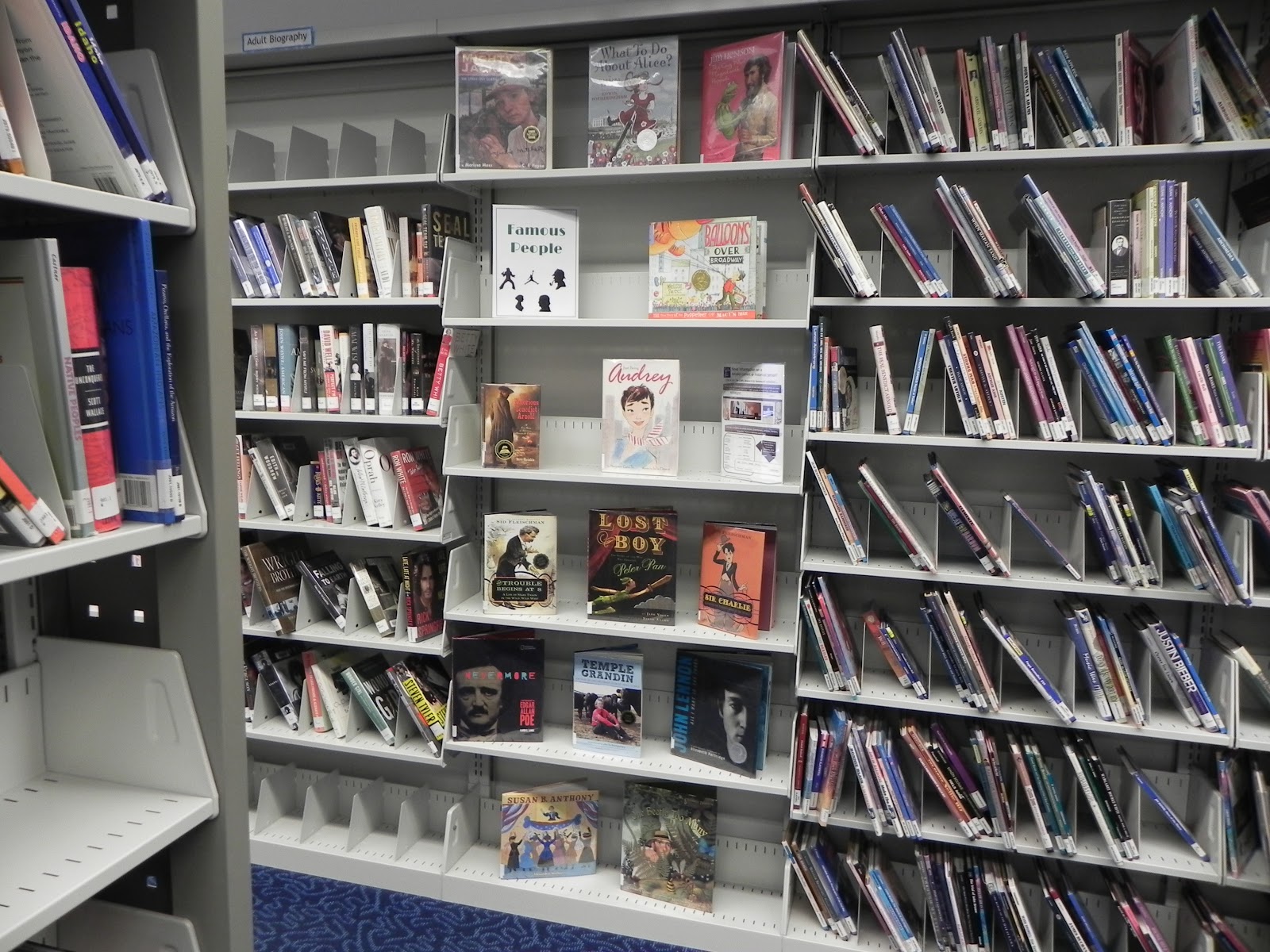
This year I am working on pulling out parts of our nonfiction collection that sometimes get overlooked to promote with the new Common Core standards and school assignments. At my branch, we get a LOT of biography requests in late March and throughout April and most of the kids want people that they can remember (lots of George Washington and Abraham Lincoln requests). If you work in a public library, you know that as soon as the first kid or so hits the collection, all of those books are gone. This month's display is called "Famous People" and I am adding biographies on people that you don't always think of along with past award winners or ALSC Notable Books.
My finished product!
So how did I get here? Here are a few tips to create your own display:
1. You will want some sort of theme to hold it all together. It could be subject, color of the book covers, or just about anything that you can come up with. It does not always need a sign as long as the theme is obvious (otherwise people will just dump their leftover books on top of your display because they think it is a catch-all.) We use a sign here because our display space is in between two ranges of shelves. I really want to push that this is a display space.
2. Pick out your books. You will want to keep an eye on size and color of the book covers. You also want to keep the display interesting. Looking at a book that has a plain black cover is not interesting. Illustrations really do make a difference.
3. Now it is time to arrange your books. You will want your biggest books in the middle of the display and the smallest books at the outside (think-pyramid). If you use a pyramid design, it will naturally draw people's eyes into the display.
Now look at color. Are there any books that have some color in common so they look like they go together? You will notice that the top shelf has a burgundy/red color that goes through all of the books. The second shelf has blue on all of the covers. The books on each side are also mostly black (it would look weird to have two black books in a row, then a light blue one).
4. Is there anything else that would enhance your display? I added a sign promoting one of our databases-Biography in Context.
Just remember that a good display can increase your circulation 90% on the books that are included. This is your chance to promote your collection and to get those books to circulate!
Monday, February 4, 2013
Nonfiction Displays and Common Core
One of my goals this year is to get all of those great nonfiction materials that we order into the hands of teachers. With the new Common Core standards being implemented, the emphasis is on more quality nonfiction.
Displays are an easy way to collect books on a theme and put them in the hands of our users. Plus, displays increase circulation. One study has displays increasing circulation 90% for books that were on the shelf. Since I am just happy if they go out, a display seemed like a good first step. Unfortunately, our building has almost no display space. What we did have, though, was an empty range of shelves. By shifting the shelves around, I made it look more like a separate entity, rather than books just standing up on the shelves.
This month's theme is "Nonfiction Award Winners". With the recent announcements of the Sibert Award and ALSC Children's Notables, this is a great time to highlight some of those titles. I figure that I will shift it around ever month or so to highlight a new nonfiction area or homework topic.
Displays are an easy way to collect books on a theme and put them in the hands of our users. Plus, displays increase circulation. One study has displays increasing circulation 90% for books that were on the shelf. Since I am just happy if they go out, a display seemed like a good first step. Unfortunately, our building has almost no display space. What we did have, though, was an empty range of shelves. By shifting the shelves around, I made it look more like a separate entity, rather than books just standing up on the shelves.
This month's theme is "Nonfiction Award Winners". With the recent announcements of the Sibert Award and ALSC Children's Notables, this is a great time to highlight some of those titles. I figure that I will shift it around ever month or so to highlight a new nonfiction area or homework topic.
I created this display late Friday and by Monday morning, almost half of the books were gone. That is pretty gratifying for little effort. To refill the empty spaces, I am now adding previous award winners too since I didn't specify a year on the sign.
I think that my first step towards my goal is a success! Now onto project #2-nonfiction teacher newsletters.
Subscribe to:
Posts (Atom)